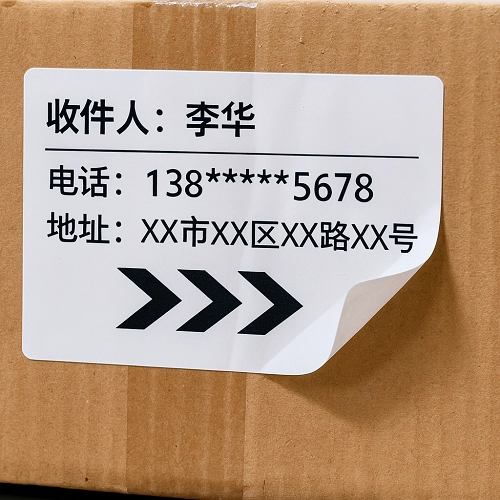
Thermal labels are self-adhesive labels printed using direct thermal printing technology — no ink, toner, or ribbons required. The label face material contains a heat-sensitive coating that darkens when it passes over a thermal printhead, producing sharp, scannable text, barcodes, and QR codes in an instant.
Because they eliminate consumables like ink cartridges and ribbons, thermal labels are a popular choice for high-volume labeling in logistics, retail, pharmaceuticals, food and beverage, and industrial manufacturing.
A thermal label is made up of several layers:
When a label roll feeds through a direct thermal printer, the printhead applies precise heat to the face coating, forming the printed image. There is no transfer of ink or toner — the image is created entirely within the label material itself.
Not all thermal labels offer the same level of protection. Guanhao supplies four main grades to suit different performance needs:
The standard, cost-effective option for everyday indoor labeling — POS receipts, supermarket price tags, and general barcode printing. Images typically last 6–12 months under normal indoor conditions. View product →
A step up from the ordinary grade, offering waterproof, oil-proof, and scratch-proof performance at an accessible price point. Ideal for high-volume logistics and e-commerce applications where labels face moderate handling. Image life extends to 1–2 years. View product →
Premium-grade protection against water, chemicals, and abrasion for demanding environments such as cold-chain distribution and industrial labeling. Delivers image durability of 2–5 years with reliable outdoor performance. View product →
A multi-layer construction using synthetic film as the face material, offering the highest tear resistance and extended image life of 3–5 years. Suited to harsh applications such as tire labeling and electronics tracking. View product →
Thermal labels are used across virtually every industry that requires fast, reliable identification and tracking:
No ink or ribbons needed. Direct thermal printing means lower running costs and less printer maintenance compared to inkjet or laser alternatives.
Fast print speeds. Thermal printers produce labels rapidly, which is essential for high-throughput warehouse and retail environments.
Sharp barcodes and QR codes. The heat-reactive coating produces high-resolution output that meets GS1 scanning standards.
Eco-friendly adhesive. Guanhao's labels use a water-based acrylic adhesive that is REACH and RoHS compliant — safe for food-adjacent and pharmaceutical packaging.
Wide range of protection levels. From basic indoor labels to three-proof grades that resist water, oil, and scratching, there is a thermal label for every environment.
Flexible formats. Available in rolls, sheets, and custom die-cut formats with OEM and private-label production supported.
"Three-proof" refers to a label's resistance to three common threats: water, oil/chemicals, and physical scratching.
| Feature | Ordinary Grade | Three-Proof Grade |
|---|---|---|
| Waterproof | ✗ | ✓ |
| Oil / chemical resistant | ✗ | ✓ |
| Scratch resistant | ✗ | ✓ |
| Suitable for outdoor use | ✗ | ✓ (high-quality grade) |
| Typical image life | 6–12 months | 1–5 years |
Ordinary labels are perfectly suited to indoor, short-life applications. Three-proof labels are the right choice wherever labels will be exposed to moisture, handling, temperature variation, or outdoor conditions.
Image durability depends on the grade chosen and the storage and use conditions:
Unused label stock should be stored at 5–25 °C, 45–65% relative humidity, in the original packaging and away from direct light to preserve coating sensitivity.
Consider these four factors:
If you are unsure which grade best fits your application, Guanhao's technical team can recommend the right product. Contact us →